
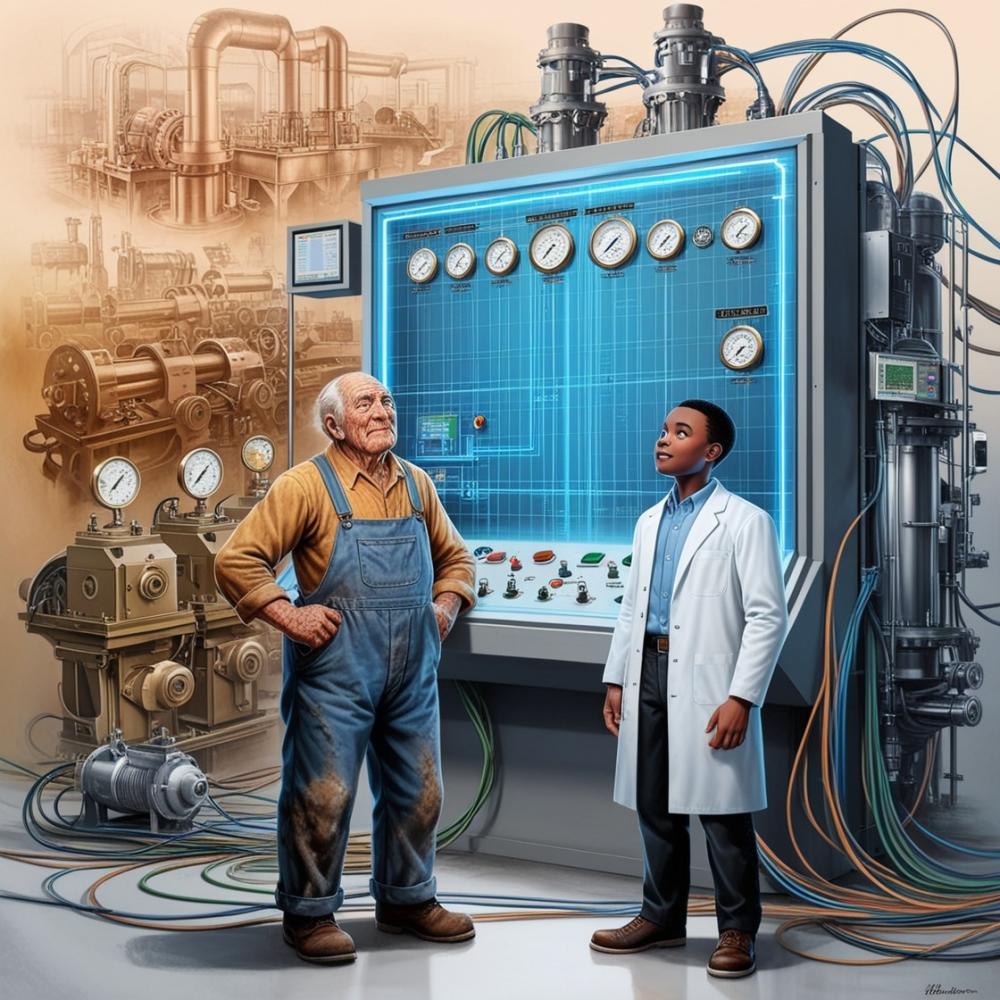
History of Control systems
The history of control systems spans centuries of development and innovation, witnessing various stages of technological and scientific advancement. Here’s an overview of some key milestones in the history of control systems:
Ancient Times
- Primitive Inventions: The concept of control dates back to ancient times, where the Greeks and ancient Indians used simple mechanisms like levers and pulleys to control movement.
17th Century
- Early Theoretical Concepts: In the 17th century, scientists such as **Galileo* and *Descartes* began exploring physical concepts that led to a deeper understanding of motion.
18th Century
- Steam Control: In 1788, James Watt invented a control device known as the "safety valve" for steam engines, allowing for better control of pressure.
19th Century
- Automatic Control Systems: In the 19th century, automatic control systems began to be used in industries, with the development of machines that operated independently of human intervention.
20th Century
- Control Theory: In the mid-20th century, modern control theory was developed. **Norbert Wiener* introduced the concepts of "automatic control" and "information theory," leading to the application of mathematics in designing control systems.
- Digital Control*: In the 1950s and 1960s, digital control systems emerged, with computers being used to manage complex systems.
21st Century
- Intelligent Control: With technological advancements, techniques such as artificial intelligence and machine learning have been integrated into control systems, enhancing performance and efficiency.
- Advanced Applications: Today, control systems are used in various fields, including robotics, autonomous vehicles, aircraft, and smart factories.
Control systems are fundamental elements in modern engineering, used in a wide range of applications, from cars and airplanes to factories and robots. The primary goal of control systems is to manage the behavior of dynamic systems to achieve a specific performance, ensuring system stability and efficiency.
Concept of Control Systems
Control systems are defined as a collection of components used to monitor and manage the behavior of a particular system. They can be classified into two main types: open-loop control systems and closed-loop control systems. In open-loop control systems, commands are executed without any feedback, while closed-loop control systems rely on data derived from the system to adjust commands and improve performance.
Modern applications of control systems
Control systems are present in our daily lives in various ways. For example, they are used in cars to control speed and braking systems. In airplanes, control systems are employed to maintain the stability of the aircraft during flight. In factories, automated control systems are used to enhance efficiency and reduce waste.
Key Elements
Control systems consist of several components, including:
1. Sensors: To collect data from the system.
2. Controllers: To analyze data and make decisions.
3. Actuators: To execute the commands based on the controller's decisions.
4. Feedback System: To evaluate the system's performance.
Challenges
Control systems face numerous challenges, such as dealing with noise and external disturbances. To achieve better performance, advanced techniques like intelligent control and machine learning are utilized.
Conclusion
Control systems are an integral part of many industries and applications. With the advancement of technology, it is expected that control systems will witness further innovation and development, contributing to improved system efficiency and sustainability